

Key Takeaways:
- Acne isn’t just for teenagers. It can carry on into adulthood or show up for the first time after 30.
- Hormones, stress, skincare products, medications, and genetics can all be involved.
- Where the pimples appear can’t confirm that the acne is hormonal.
- The right treatment depends on the cause, the severity, and your skin type.
- If acne comes on suddenly or won’t go away, get it assessed by a professional.
Plenty of people assume acne ends with the teenage years. For many adults, it never fully does, and for others it turns up out of nowhere after 30. Hormones, stress, the products you use, and your everyday habits can all feed into it. Since the trigger is different for everyone, treatment works best when it targets what’s actually behind your breakouts.
Why Does Acne Happen After 30?
Usually it’s a mix of things. Hormonal fluctuations push up oil production, and that extra oil clogs pores. Stress and lifestyle habits make it worse, and so can skincare or makeup that blocks pores. Some medications and underlying health conditions can set off breakouts too.
For some people, acne simply carried on from adolescence. Genetics and your individual skin type matter as well, which is why one person breaks out under stress and another doesn’t.
If acne shows up suddenly or just won’t settle, have it looked at. Putting it down to your skincare routine can delay the right diagnosis.
Hormonal Acne After 30: What Does It Look Like?
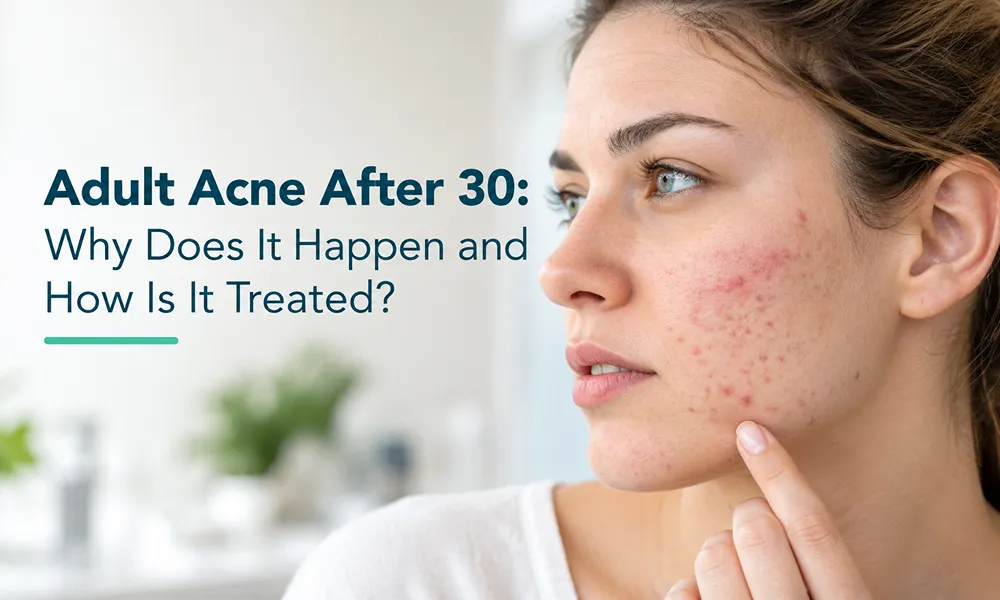
Related hormonal changes make your skin more oily and inflamed. So breakouts are usually periodic. They may emerge around the time of hormonal changes or return around the same time every month or so and tend to be centred on the chin, jawline and lower face.
Still, location alone doesn’t prove acne is hormonal. Acne on the cheeks, for example, can come from friction, products, or genetics. A dermatological assessment can pinpoint the likely trigger, so you’re not treating a guess.
Other Factors That Can Trigger Adult Acne
It could also be stress or lack of sleep. Skincare and beauty products may lead to whiteheads if they clog your pores, and sweat and friction from a helmet, mask or phone may do the same. If you’re about to take on a new role or head off on holiday, that might bring one on.
Diet can also be a factor in some individuals, but there is no single food that causes acne for all people, so avoid generalising rules. Some other medications and medical conditions can also cause breakouts. If your breakouts persist, our post on why acne keeps coming back and getting worse describes the typical reasons.
Treatment of Adult Acne
The treatment should be realistic. If you have different types of acne and they have different causes, you may need a combination of treatments. This could include topical treatments for blockages and inflammation, prescribed drugs where needed, or hormonal treatments for a few patients. Certain types of acne respond very well to treatment. Skincare and lifestyle changes usually go alongside all of this.
What’s right for you depends on severity, skin type, triggers and how you responded to past treatments. That’s why seeing a specialist beats trying one product after another.
At The Esthetic Clinics®, our dermatology specialists assess your skin and any underlying factors before recommending an acne treatment approach. Patients seek TEC® for acne treatment in Mumbai and all over India, and this guide to the best treatment for acne in Mumbai explains what to anticipate.
How Can You Reduce Adult Acne and Prevent New Breakouts?
Stick with your routine as much as possible, but make it simple and gentle. Use non-comedogenic (pore blocking) products for your skin and make up, if possible. Cleansers that are too drying will only make your skin worse, so don’t over-do it with washing.
Don’t pop or squeeze and don’t stop whatever treatment plan (if any) you have to use by a certain date, as this is a common cause of a recurrence. Find the specific trigger in you, such as food. Rather than cutting out entire food groups, as restriction diets are unsupported by science.
When Should You See a Dermatologist for Acne After 30?
Schedule a visit if your acne starts suddenly and doesn’t go away after 30 days, or if you notice your pimples have a painful, cystic quality to them or keep showing up on your face and chest. Acne that leaves dark marks or scars needs attention early, and our article on acne scars and their treatment has more on that. You should also see a specialist if basic skincare isn’t making a difference, or if the acne comes with other symptoms that could point to a hormonal or medical problem.
Adult acne can have many contributing factors. Hormones are one possible cause but not the only one, so don’t try to diagnose yourself from where the breakouts show up or from a single trigger. The right treatment depends on the type and severity of your acne and on your skin. To plan yours with TEC®, schedule a consultation today.
FAQs About Adult Acne After 30
Is it normal to suddenly develop acne after 30?
Yes, it’s quite common. Hormonal shifts, stress, new products or medications can all start it. If it appears suddenly or doesn’t clear up, get it checked.
Can hormonal changes cause acne after 30?
Yes. Hormonal fluctuations can increase oil production and inflammation. They’re one possible cause, but not the only one.
Why do I keep getting acne on my cheeks after 30?
Cheek acne can come from friction, products, sweat, hormones or genetics. A dermatologist can tell you which one applies to you.
Can diet cause acne in adults?
It may affect acne in some people, but no food causes it for everyone. Track your own pattern before you cut anything out.
Can adult acne go away permanently?
Many people get it under control for the long term, but it can come back if the underlying cause isn’t managed. Ongoing care often matters more than a one-time fix.
Does adult acne leave scars?
It can, especially when breakouts are deep, inflamed or picked at. Treating it early lowers the risk.
How long does adult acne treatment take to work?
It varies, but most treatments take several weeks before you see a clear improvement. Your dermatologist will give you a realistic timeline.
What is the difference between hormonal acne and regular adult acne?
Hormonal acne is linked to hormonal fluctuations and often appears on the lower face. Other adult acne has different triggers. Location alone can’t tell them apart, so an assessment is the reliable way to know.
Can adult acne be treated without prescription medication?
Mild acne may respond to suitable topical products and a steady routine. Persistent or painful acne usually needs professional guidance.