
Key Takeaways
- Facial fat grafting uses your own fat to rebuild volume in selected areas of the face.
- Some of the transferred fat is lost after the procedure, so results vary.
- Donor fat, facial anatomy and overall health decide who is a good candidate.
- A proper consultation should come before any decision.
Facial Fat Grafting: How Fat Transfer Can Restore Facial Volume
You probably notice it most in photos. Cheeks are flatter, temples appear a little more hollow and there is no longer a clean line to the skin under your eyes. To combat these changes, facial fat grafting can be used to bring the volume back where you need it. Outcomes and indications vary per individual.
What Is Facial Fat Grafting?
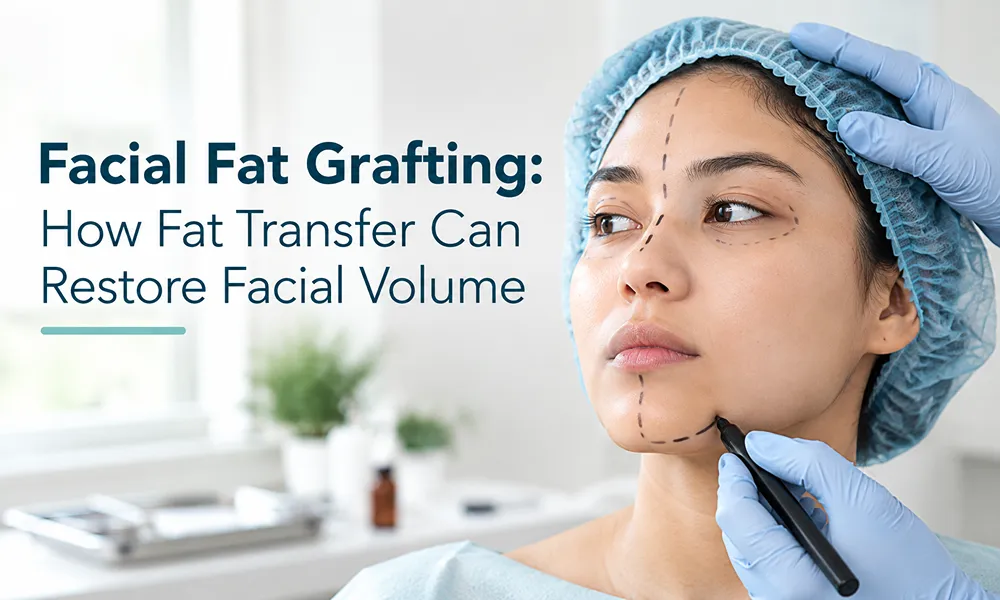
Facial fat grafting, also referred to as a facial fat transfer, is a surgical procedure. During the procedure, fat from elsewhere on the body is harvested, purified, then injected back into select areas of the face. The most common facial areas that receive fat injections are the cheeks, temples, under-eye area, and any other area that has noticeable volume loss.
The goal is to restore lost volume and create shape, not to add fullness overall to the face. As the material is obtained from the patient’s own body, autologous fat transfer to the face is attractive for people who prefer not to use synthetic fillers.
How Does Facial Fat Transfer Restore Facial Volume?
The facial fat transfer treatment follows a fixed order of steps. At The Esthetic Clinics®, where Dr Debraj Shome, a cosmetic and reconstructive plastic surgeon, and his team carry out these procedures, it runs like this.
- Assessment and planning. The surgeon studies where volume has been lost and decides whether fat grafting suits the patient.
- Fat harvesting. Fat is collected gently from a donor area, commonly the abdomen or thighs.
- Fat preparation. The collected fat is processed so that it is ready for transfer.
- Fat placement. Small amounts are placed carefully into the selected facial areas.
- Healing and settling. The transferred fat goes through an initial healing phase before the result stabilises.
TEC® specialists plan placement around each patient’s facial anatomy and personal goals, not a standard template. This is one reason many patients in Mumbai and across India choose TEC® for facial volume restoration.
Which Areas Can Facial Fat Grafting Treat?
The cheeks are the most common site, where fat helps restore lost volume and supports the contour. The temples are another, since hollowing there can make the face look tired or gaunt. In selected cases of volume deficiency, the under-eye area can also be treated. Depending on assessment, nasolabial folds and other facial depressions may be considered too, and the overall contour can be rebalanced where proportion has been lost.
Not every patient needs treatment in every one of these areas. A careful evaluation decides where fat transfer will actually help.
Is Facial Fat Grafting Permanent? How Long Does It Last?
Patients ask this more than anything else. Part of the transferred fat does not survive after transplantation, and surgeons expect this. The fat that builds a new blood supply and stays can give longer-lasting volume than temporary fillers.
Swelling in the early weeks means that the face initially appears swollen and rounded. So the first few weeks are misleading. Of course, from then on, many years of ageing, large weight gains or losses and each person’s personal biology can influence the fat transfer result.
Facial Fat Grafting Recovery and Risks
Swelling and bruising are common for a few days. It takes the face and the donor site a little time to recover, which depends on the extent of the procedure.
However, you may experience swelling, bruising and temporary asymmetry. Infection, irregularities of the skin or contour, and uneven fat resorption or retention are less common but can also occur. Additional complications are specific to the procedure you are having.
TEC® experienced personnel provide specific instructions for the surgical procedure and follow-up care to ensure optimal healing.
Who May Be Suitable for Facial Fat Grafting?
Suitable adults include those with facial volume depletion or specific contour issues. Adequate donor fat, good health and manageable expectations are also factors. Ultimately it is down to the facial anatomy, what you want to achieve and your overall health and well being. Not all forms of facial ageing are suitable for fat transfer.
Facial fat grafting replaces some areas of facial volume with your own fat. Effectiveness varies with fat retention, healing, natural anatomy and age. That’s why a personalised evaluation before treatment is essential. If you’re considering fat grafting for yourself, book an appointment at TEC® in Mumbai or at our facility throughout India.
FAQs About Facial Fat Grafting
What is the Cost of Facial Fat Grafting in India?
The cost varies on the treated areas, amount of fat needed, surgeon’s experience and the facility. Cannot provide a set price without an evaluation. The best way to get an accurate estimate is to have a consultation.
Is face fat transfer safer than fillers?
Since it comes from your own body, there is no reaction to a foreign material. It is a surgery, so it carries its own risk, and whether it is safer or not is a personal decision.
How long does the procedure of grafting of the facial fat take?
The procedure generally takes several hours, which can vary based on the number of treatment areas and the amount of fat you’re removing. Your doctor can give you a more specific answer after examining you.
Is it possible to reverse fat grafting?
Not very. Because fat that’s already there can’t be easily dissolved as some fillers can, precise placement is especially important.
Can facial fat grafting be combined with a facelift?
A facelift addresses tissue that is sagging, and fat grafting improves volume loss. Therefore, the two procedures complement each other.
What happens if transferred facial fat is absorbed?
Absorption is expected. If a significant amount of volume is absorbed, your surgeon may recommend a touch-up after the area has healed completely.
Will gaining weight or losing weight impact the results of facial fat grafting?
Yes. As the transplanted fat can act as fat elsewhere on the body, drastic weight fluctuations will change the overall appearance.